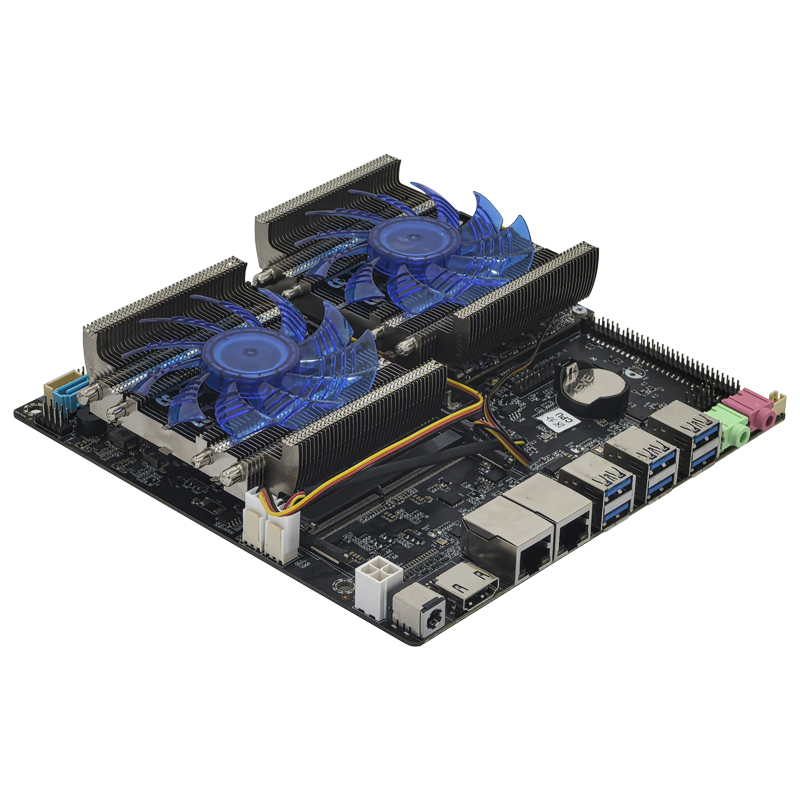
ELSKY HT3300 Domestic Hygon 3350 Indutrial Motherboard
Dual Network Ports
| Motherboard size | 170mm (L) * 170mm (W) * 24 mm (H) including radiator height: 170mm (L) * 170mm (W) * 38 mm (H) | ||
| CPU | Supports domestically produced Hygon 3350, 3350E, 3330, 3330E, etc. | ||
| Power supply | 1*DC_ IN | The DC connector has an inner diameter of 2.5mm and supports 12V/19V.
The motherboard consumes approximately 180W under full load ; a 12V 15A or 19V 10A or higher power supply is recommended. |
|
| 1*ATX (4-pin) | |||
| Memory | 2*SO DIMM slots | NB-DDR4 memory, supports 2133/2400/2666/3200 MHz memory, maximum support 64 GB. | |
| Network function | 1/2*LAN interface | Dual-network: Supports 2*Yutaiwei YT6801 Gigabit network cards, can be modified to support 2*Realtek 8111H Gigabit network cards;
Three networks: Supports 3*Yutai Micro YT6801 gigabit network cards, can be modified to support 3*Realtek 8111H gigabit network cards; Four-network: Supports 4*Yutaiwei YT6801 gigabit network cards, can be modified to support 4*Realtek 8111H gigabit network cards; Supports Wake-on-LAN ; PoE power supply cannot be modified; PXE is not supported. |
|
| 1*M2_WIFI interface | Supports Key-E interface M.2 2230 PCIe 4.0 x1 & USB, and supports WiFi and Bluetooth modules. | ||
| 1*M2_4G/5G interface | Supports Key-B interface M.2 5G (3052/3042) modules or M.2 4G (3042) modules. | ||
| Display function | Dedicated graphics card | 1*MXM slot (If no MXM graphics card is connected, the motherboard will not display anything). | |
| The display supported by the motherboard is determined by the MXM graphics card. | |||
| 1* HDMI1® port | The motherboard’s HDMI1® interface has a resolution determined by the MXM graphics card. | ||
| 1*HDMI2® interface | The motherboard has an HDMI2® port ; the resolution is determined by the MXM graphics card. | ||
| Note: The motherboard does not support HDMI_CON header display. | |||
| 1*LVDS /EDP1 pin | Supports resolution 1920*1080@60Hz ( 30Pin, 2*15Pin, 2.0mm) | ||
| The LVDS/EDP1 header supports LVDS by default and can be modified to support EDP1, sharing the same header; EDP1 uses an EDP-B screen cable (20-pin separate screen cable for backlight) ; the display of LVDS and EDP1 on the motherboard is determined by the MXM graphics card; LVDS resolution only supports 1920×1080@60Hz. | |||
| 1*LVDS_PWR pin | LVDS /EDP1 operating voltage control pin (6-pin, 2*3-pin, 2.0mm) | ||
| 1*INVERT pin | LVDS backlight control pins (6-pin, 1*6-pin, 2.0mm) | ||
| The motherboard supports MXM graphics cards by default, including Jingjia Micro JM9100/MJ7201/GS7201 and Xindong Fenghua II graphics cards; if using MXM graphics cards such as 1030/1650/1050Ti/3050, the motherboard hardware needs to be modified. | |||
| USB function | 6 USB 3.0 ports | rear-mounted standard USB 3.0 port with a maximum bandwidth of 5Gbps. | |
| 1*F_USB 1- pin connector | Front-mounted USB 2.0 header, one set has 2 USB 2.0 ports.
(9-pin, 2*5-pin, 2.0 mm ) |
||
| 1*F_USB 2- pin connector | Front-mounted USB 2.0 header, one set has 2 USB 2.0 ports.
(9-pin, 2*5-pin, 2.0 mm ) |
||
| Sound function | By default, it supports SMIC’s domestically produced CJC6811A USB sound card chip. | ||
| 1*LIN_OUT interface | Supports audio output (green) | ||
| 1*MIC_IN interface | Microphone input is supported (red). | ||
| 1* INT_SPK pin | Supports 8 ohms 5 watt speaker output (amplifier)
(4-pin, 1*4-pin, 2.0mm) |
||
| 1*F_AUDIO pin | Standard audio pins (9-pin, 2*5-pin, 2.54mm) | ||
| Hard drive function | 1*NGFF interface | Supports Key-M interface M.2 2280 NVME PCIe 4.0 x4 / SATA adaptive standard SSD;
Optional M.2 2242 hard drive; |
|
| 1*SATA1 interface | Standard SATA hard drive interface, supports SATA 3.0 | ||
| 1*SATA_PWR 1- pin connector | The hard drive power supply pins can draw 5V or 12V power.
(4-pin, 1*4-pin, 2.54mm) |
||
| On/off function | 1*F_PANEL pin | Switch, power indicator, hard drive indicator, reset pin
(9-pin, 2*5-pin, 2.54mm) |
|
| 1*AUTO_SW pin | Hardware control power-on pins (3-pin, 1*3-pin, 2.0mm) | ||
| Other I/O | 1*COM1 pin | Supports standard RS232 / RS422 / RS485 optional (9Pin, 2*5Pin, 2.0 mm ) | |
| 1*COM2 pin | Supports standard RS232 / RS485 (9Pin, 2*5Pin, 2.0 mm ) . | ||
| COM3-6 pins | Serial port, supports standard RS232; (39Pin, 2*20Pin, 2.0mm) | ||
| 1*CPU_FAN 1 pin | CPU fan header , supports temperature control
(3-pin, 1*3-pin, 2.54mm) |
||
| 1*GPU_FAN/SYS_FAN pin | The system fan header does not support temperature control . (3-pin, 1*3-pin, 2.54mm) | ||
| 1*GPIO1 pin | GPIO control pins (10Pin, 2*5Pin, 2.0mm) | ||
| 1*CLR_CMOS pin | Motherboard discharge, zeroing pins (3-pin, 1*3-pin, 2.0mm) | ||
| 1*SIO-UPDATE pin | SIO’s FW update pins (3-pin, 1*3-pin, 2.54mm) | ||
| 1*J1 pin | Adjustment pins (3-pin, 1*3-pin, 2.0mm) | ||
| Operating environment | Operating temperature: 0℃~ 45 ℃;
Operating humidity: 5%~95% relative humidity, non-condensing. |
||
| BIOS | Supports power-on upon startup, scheduled power-on, and intelligent identification of remote power on/off devices. | ||
| Operating system | Jingjia Micro JM7201/GS7201/JM9100: Supports Kylin and Tongxin systems, but does not support Windows systems;
1030/1050ti/1650/3050/RX550: Supports Windows 10, Windows 11, Ubuntu, Kylin, UnionTech systems, etc. ChipPower FengHua II: Supports Windows 10, Windows 11, Kylin, and Tongxin operating systems; |
||
Product Overview
The motherboard utilizes industrial-grade components and a wide-temperature design, supporting operation in environments ranging from -10°C to 60°C and ensuring stable, continuous 24/7 performance; it is widely used in IoT sectors such as industrial automation, machine vision, smart commercial displays, and medical imaging.
Core Advantages

Industrial Automation
Production Line Control, Equipment Monitoring, Data Acquisition

Machine Vision
AI Visual Inspection, Image Recognition and Analysis

Smart Commercial Displays
Digital Signage, Advertising Displays, Information Dissemination Terminals

Medical Imaging
Medical Imaging Terminals And Diagnostic Equipment

Smart Transportation
Traffic Signal Control And Road Network Monitoring

IoT Gateway
Data Aggregation And Edge Computing Nodes